ABOUT
PLASMOIDS and the Thunderstorm Generator
The science behind a cleaner, more efficient engine
Revolutionary Technology for Zero Emissions and Fuel Savings. The alternative to Carbon Capture and Storage isn't more infrastructure — it's a cleaner burn, with 20%+ fuel savings built in.
What we do
Plasmoid Power exists to make the engines already running the world's diesel, petrol, and natural gas generation cleaner and more efficient — without asking operators to replace equipment that still has years of working life left in it. Proven and validated, backed by global testing: we're reorganising energy, one engine at a time.
- CO-CO2-VOC Reduction: 98% — independently verified
- Fuel Savings: 20%+ on diesel and petrol gensets (conservative, in-house tested)
Manufacturing and IP
Plasmoid Power is the manufacturer of the Thunderstorm Generator (TSG) — a plasmoid-based retrofit technology that improves combustion efficiency and reduces emissions in diesel, petrol, and natural gas engines and generator sets. The TSG is manufactured to a single tested specification, ensuring consistent quality and performance across every unit deployed, wherever in the world it ends up running.
Beyond the fuel savings, it extends the working life of the engines it's fitted to — making them cleaner without taking them offline.
THE SCIENCE
Grounded in plasmoid physics.
What is a plasmoid?
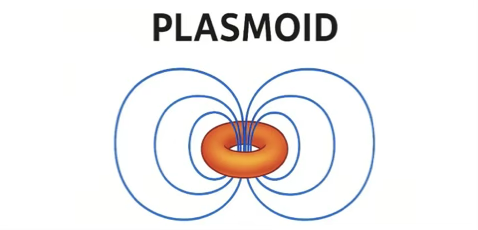
You've probably never heard the word — but you may have seen a description of one without knowing it. Ball lightning, the rare glowing orbs some people report seeing during storms, is one of nature's best-known examples. In plain terms, a plasmoid is a self-contained pocket of electrically charged gas that holds its own shape, generating its own magnetic field as it forms — a bit like a smoke ring that doesn't dissolve, because the ring itself is what holds it together. First characterised by physicist Winston Bostick in 1956, a plasmoid's defining property is that it implodes: the structure collapses inward, concentrating energy at the point of collapse — a dynamic the TSG applies directly to combustion.
A plasmoid holds together because two opposing forces are in balance: the outward push of the hot, ionised gas (plasma pressure) and the inward pull of its own magnetic field (magnetic pressure). This branch of physics — the study of how magnetic fields and electrically conducting fluids interact — is called magnetohydrodynamics, or MHD for short.
Take away the confining field and a plasmoid disperses almost immediately — in a field-free vacuum, it expands and dissipates in a fraction of a second. Inside a confining magnetic geometry, however, it remains coherent, and can store and release large amounts of energy through a process called magnetic reconnection — field lines breaking and reconnecting into a new configuration. This is the same basic mechanism behind solar flares and the aurora.
How the Thunderstorm Generator Creates and Uses Plasmoids
The TSG is engineered to generate plasmoid-like structures on demand, using a controlled, repeatable process, putting them to work as exhaust gases pass through the device — in three stages:
- Ionisation — incoming air is electrically conditioned, energising electrons ahead of the next stage.
- Cavitation — air and water interact through microbubble cavitation; as the bubbles collapse, they create the conditions for small-scale plasmoid formation.
- Vortex / reactor stage — the mixture enters a counter-rotating vortex, where the plasmoids interact with hot exhaust gases and are brought into direct contact with pollutant molecules.
Trigger
The temperature differential between hot exhaust and cooler intake air initiates the process. No external power required.
Cavitation
Air is drawn through a small quantity of water and together with catalysts initiate small cavitation bubbles. These are caused by the suction generated from the inlet stroke of the engine.
Plasmoid generation
This cavitation, combined with UV pre-ionisation of the incoming air and fuel vapour, generates the coherent plasma structures — plasmoids — described below.
Conditioning
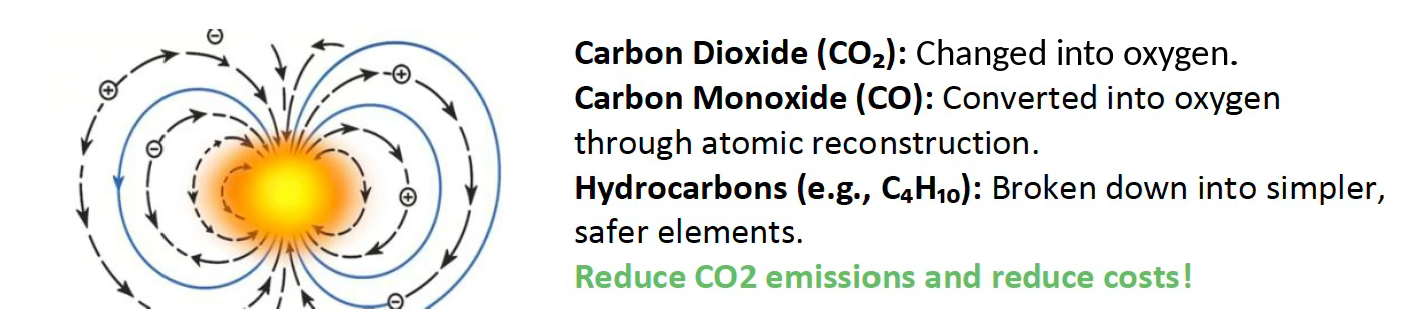
The plasmoid-conditioned gas stream shows a measured increase in oxygen content and a corresponding drop in CO2, CO and hydrocarbons — the effect independently certified in testing.
Recirculation
Counter-rotating vortex geometry feeds the conditioned, oxygen-enriched stream back into the combustion chamber, recovering energy otherwise lost out the exhaust stack — driving a more complete burn, less fuel used, and fewer emissions.
THE ROAD AHEAD
Where the Technology Goes From Here
Plasmoid Power Motorbike
Plasmoid Power Diesel Truck Retrofit
Gas Turbine Retrofit
Coal Power Station Retrofit
Gas Power Station Retrofit
Cement and Industrial Kiln Retrofit
Waste to Energy
Eco Data Centers
Beyond these programs, our team continues to explore frontier plasma physics as part of our longer-term research horizon.
Join Us in Building What Comes Next
The world runs on combustion — and it can't afford to keep burning fuel the old way. The Thunderstorm Generator is already working in the field, cutting fuel use and emissions on real engines today. These R&D programs take that same technology further, into transport, heavy industry, waste and power generation, where the impact on fuel costs and emissions could be enormous.
Each program runs as its own venture, with dedicated teams and partners, united by one vision: cleaner, more efficient energy for a world that urgently needs it. Plasmoid Power is a key investor in every one of them, and we're moving fast.
We're looking for investors, industry partners and pioneers who want to be part of this from the ground floor. If you want to help shape a cleaner energy future — and be there as it happens — we want to hear from you.
Contact us at info@plasmoidpower.com to explore investment and partnership opportunities.