
Plasmoids
The Physics Behind a Cleaner, More Efficient Engine
For nearly seventy years, physicists have known that plasma can organise itself into a stable, self-contained structure — a plasmoid. NASA studies them in solar flares. Fusion energy programs are racing to harness them. And the Thunderstorm Generator (TSG) puts that same physics to work inside a combustion engine — cutting harmful emissions by up to 99% while improving fuel efficiency, using nothing but water, exhaust heat, and a precisely engineered retrofit device.
This page explains what a plasmoid actually is, the science behind it, and exactly how the TSG turns that science into a working emissions-reduction technology you can retrofit today.
What Is a Plasmoid?
A plasmoid is a self-contained structure of plasma and magnetic fields — a coherent, stable object that holds itself together through a balance of electromagnetic forces, plasma dynamics, and kinetic energy. Unlike an ordinary spark or flash of ionised gas, a plasmoid doesn't simply disperse — it organises.
Plasmoids aren't a theoretical curiosity. They occur naturally and have been studied extensively across:
- Ball lightning
- Magnetospheric plasma bubbles
- Solar wind interactions and cometary tails
- Dense plasma focus (DPF) fusion research
- Field-reversed configurations (FRCs) and spheromak formations
The Science Is Established — Not Speculative
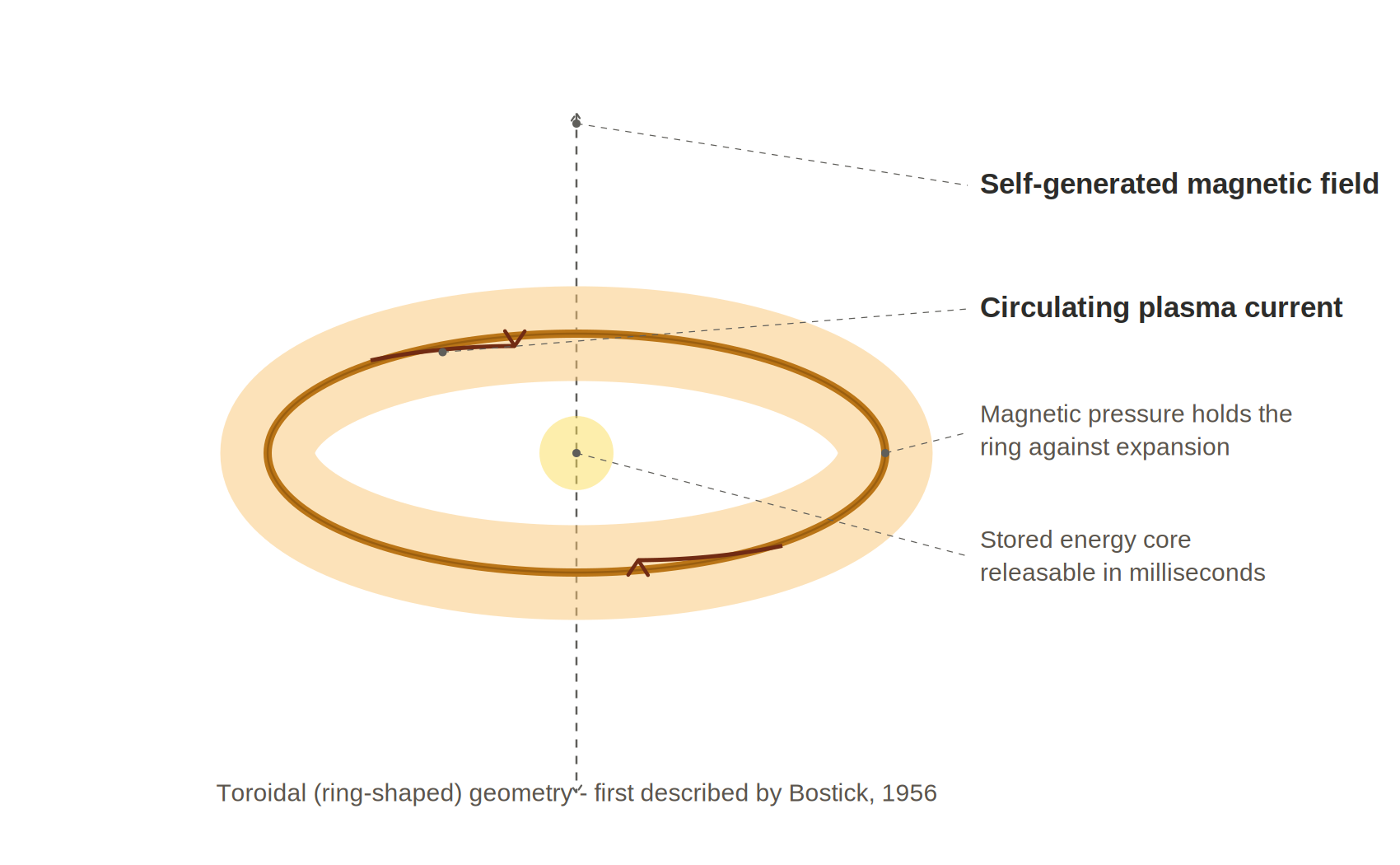
The term "plasmoid" was coined in 1956 by physicist Winston H. Bostick, who described these structures as toroidal (ring-shaped) plasma-magnetic entities exhibiting self-confinement, rotational stability, and measurable magnetic moments. Bostick observed that plasmoid behaviour closely resembled cosmic structures, leading him to propose them as an early model for galaxy formation — a sign that plasmoids are a fundamental feature of how plasma organises itself throughout the universe, not just a laboratory effect.
In the decades since, plasmoid physics has become a serious, well-funded field of study:
- NASA and ESA study plasmoids as the mechanism behind magnetic reconnection in solar flares and coronal mass ejections.
- Fusion energy programs — including dense plasma focus devices, field-reversed configurations, and spheromaks — use plasmoid confinement as a path toward compact fusion reactors.
- The US Air Force Research Laboratory, NASA, Princeton, Stanford, and MIT have all funded research into plasma-assisted combustion, consistently finding that non-equilibrium plasma improves combustion efficiency and reduces emissions.
This is the established science the Thunderstorm Generator builds on.
How a Plasmoid Holds Itself Together
Plasmoids are governed by plasma physics and magnetohydrodynamics (MHD). Their stability comes from a balance of three forces:
- Magnetic pressure (Lorentz force) — generated by internal currents, creating a restoring force against expansion
- Plasma pressure — from the kinetic motion of charged particles, pushing outward
- Electromagnetic stabilisation — twisted magnetic field lines that maintain the structure's toroidal geometry
In open, unconfined conditions, a plasmoid disperses quickly. But inside a confining magnetic field, it remains coherent — and can store and release enormous amounts of energy through magnetic reconnection, the same mechanism behind solar flares, auroras, and fusion experiments. A plasmoid can store gigajoules of energy and release it within milliseconds, which is precisely what makes it useful as a high-density energy trigger inside an engine.
How the Thunderstorm Generator Puts This to Work
The TSG, invented by Malcolm Bendall, is engineered specifically to generate plasmoids on demand, using a controlled, repeatable process — and to put them to work transforming exhaust gases as they're produced.
1. Plasmoid Generation — the TSG creates plasmoids through acoustic cavitation in water. As these cavitation bubbles collapse, they generate the conditions needed for plasmoid formation. The plasmoids then pass through a resonator, where their energy state is tuned.
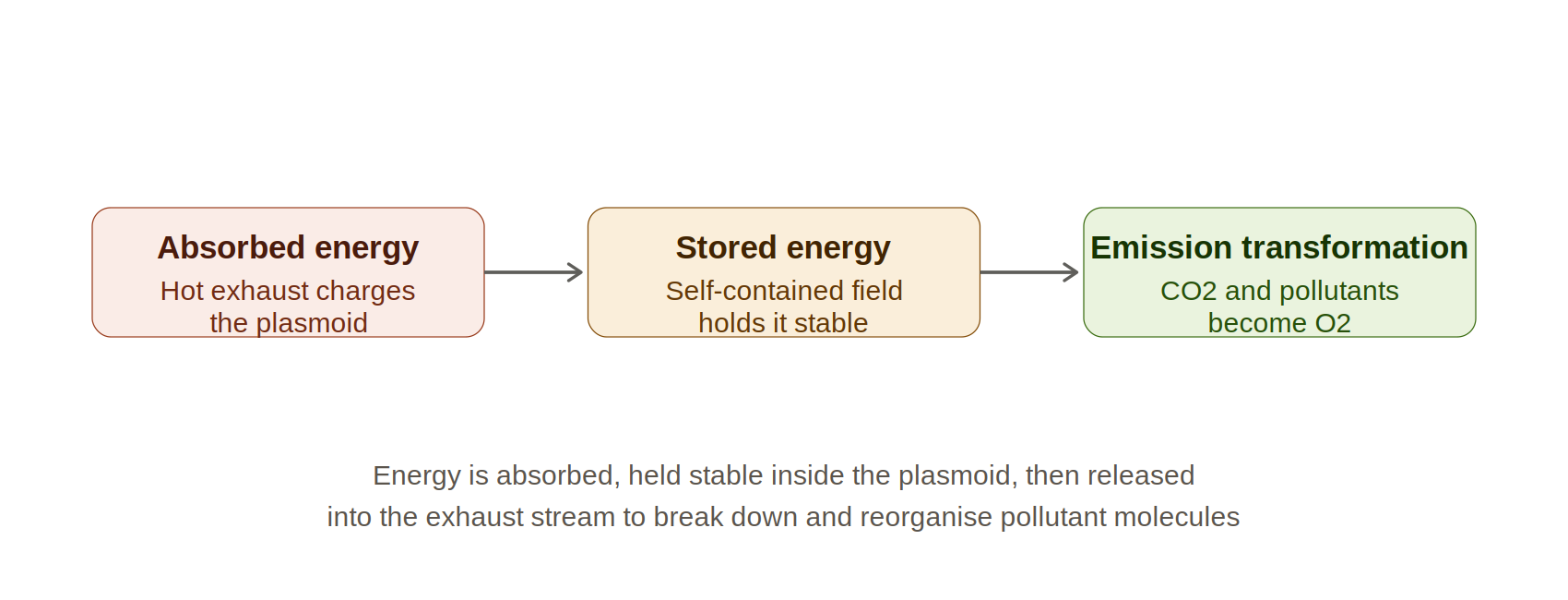
2. Exhaust Interaction — hot exhaust gases charge the plasmoids, exciting them to a higher energy state — the point at which they begin interacting directly with the pollutant molecules in the exhaust stream.
3. Emission Transformation — at this higher energy state, the plasmoids break down the molecular bonds of the pollutants passing through them.
- CO₂ is transmuted into O₂ and clean gases
- Carbon monoxide and nitrous oxides are significantly reduced
- Hydrocarbons are broken down into simpler, less harmful compounds
The result: an engine that runs cleaner and more efficiently, with no change of fuel, no engine modification, and no major downtime to install.
The Results, Independently Confirmed
| Metric | Result |
|---|---|
| CO₂ Reduction | 99.56% |
| Carbon Monoxide Reduction | 98% |
| Sulfur Dioxide Reduction | 84.8% |
| Oxygen Output | Increased to 20.97% |
This is what plasmoid-based emissions technology looks like in practice — not a theoretical promise, but a measured transformation of harmful exhaust into clean air.
Toroidal Structure of a Plasmoid
Here is a 3D visualization of a toroidal plasmoid, illustrating its self-confining plasma structure. The toroidal shape is key to plasmoid stability, allowing continuous circulation of charged particles and self-generated magnetic fields.
Plasmoid Energy Storage and Emission Transformation
This diagram shows how plasmoids absorb, store, and release energy — and how that same process transforms exhaust pollutants into clean output.
Key Features of This Diagram
- Absorbed Energy (Red Arrow) — Plasmoids take in energy from plasma and magnetic fields.
- Stored Energy (Purple Arrow) — The self-contained electromagnetic structure keeps energy stabilised.
- Emission Transformation (Green Arrow) — Plasmoids modify the molecular structure of exhaust gases, reducing CO₂ and other pollutants while increasing oxygen output.
Plasmoid Propulsion and Fusion Applications
Plasmoid physics extends well beyond combustion. Here's how the same self-contained plasma structures are being explored for propulsion and fusion energy.
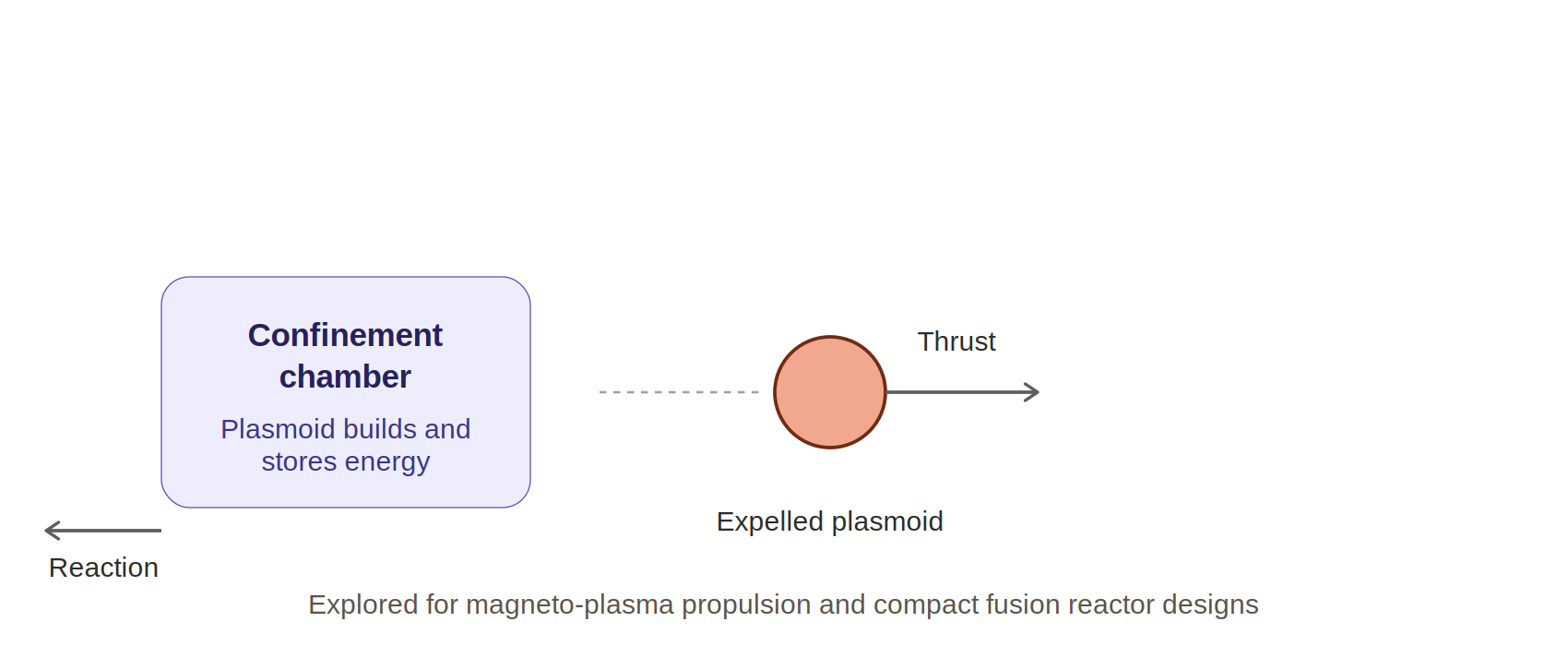
Where this research is headed
- Advanced space propulsion — plasmoid-based thrusters, potentially more efficient than traditional ion drives
- Fusion energy — plasmoids'' ability to self-contain and release energy efficiently makes them strong fusion reactor candidates
Industrial Integration: Plasmoids in the Thunderstorm Generator
This schematic shows exactly how the TSG processes exhaust gases in an industrial setting — from intake to clean output.
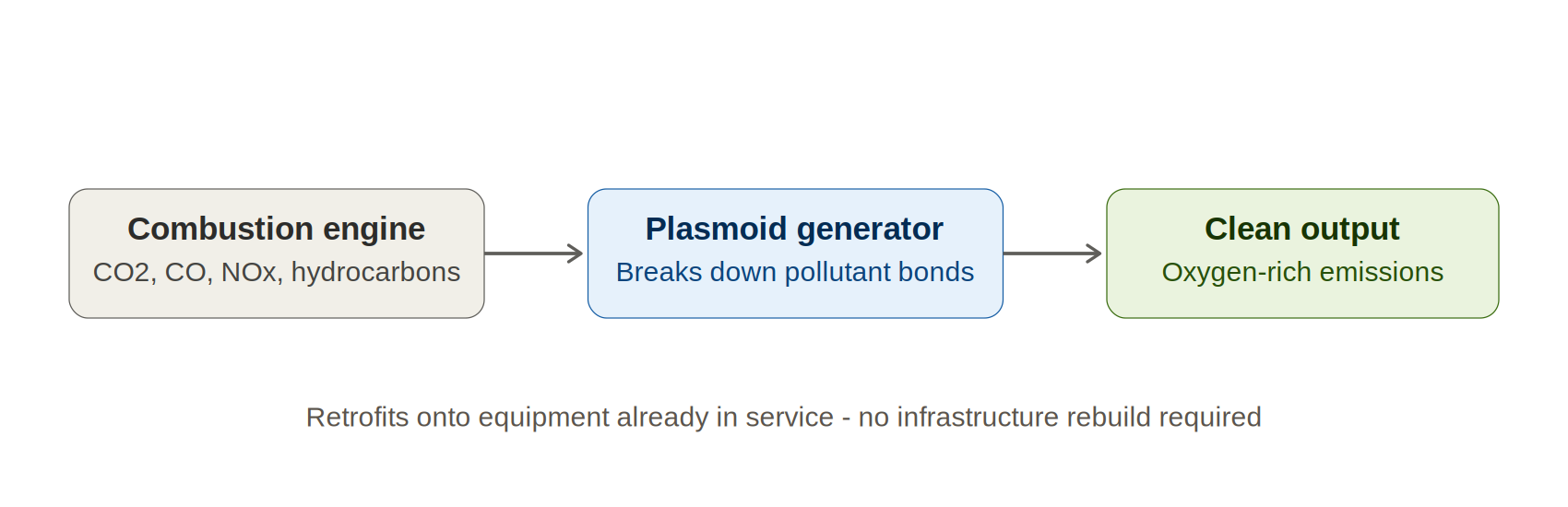
Why this matters for industry
- Significant CO₂ reduction in factories, transport, and power plants
- Retrofittable — added to equipment already in service, no infrastructure rebuild required
- Supports emissions compliance targets, turning a regulatory cost into a competitive advantage
Molecular Transmutation: How CO₂ and Hydrocarbons Are Transformed
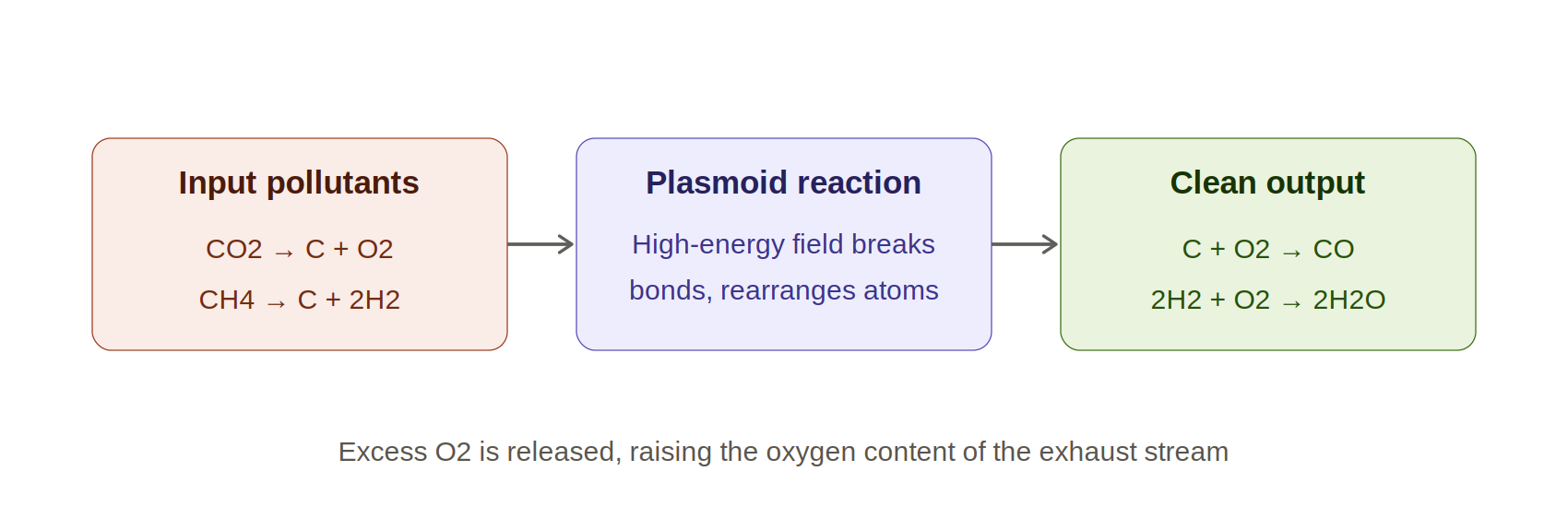
This reaction pathway shows how the TSG breaks down CO₂ and hydrocarbons like CH₄ into clean oxygen, water, and usable energy through plasmoid-induced molecular transmutation.
Key Chemical Reactions Illustrated
- Input Pollutants: CO₂ → C + O₂ · CH₄ → C + 2H₂
- Plasmoid Interaction: high-energy plasmoid fields break these molecular bonds and rearrange the atoms into less harmful compounds.
- Output Products: Carbon is captured as an inert solid, not released as a gas · 2H₂ + O₂ → 2H₂O (water) · excess O₂ is released, making the emissions cleaner.
From Astrophysics to Your Exhaust System
Plasmoid research spans an unusually wide range of fields — and the Thunderstorm Generator sits at a genuinely rare intersection of them:
- Fusion energy and advanced propulsion — plasmoids offer a self-stabilising plasma structure, one of the central challenges in fusion research and magneto-inertial propulsion.
- Environmental and industrial applications — transforming industrial waste gases into oxygen-rich emissions, and exploring plasmoids as high-density energy carriers.
- Astrophysics — plasmoid-driven magnetic reconnection helps explain solar weather, and may even inform models of galaxy formation.
The Thunderstorm Generator is one of the first technologies to take this physics out of the laboratory and put it to work solving an immediate, practical problem: the emissions coming out of the engines and industrial systems already running today.
Ready to See It in Action?
Plasmoid physics has spent seventy years being studied by astrophysicists, fusion researchers, and national laboratories. The Thunderstorm Generator is what happens when that same science is engineered into a retrofit device you can install on an engine this year.
Get in touch to discuss a demonstration, request testing data, or find your regional distributor.
"A double-edged, fiery, ever-living thunderbolt... For by its strikes all the works of nature happen."
— Cleanthes' Hymn to Zeus (3rd century BC Stoic philosopher)